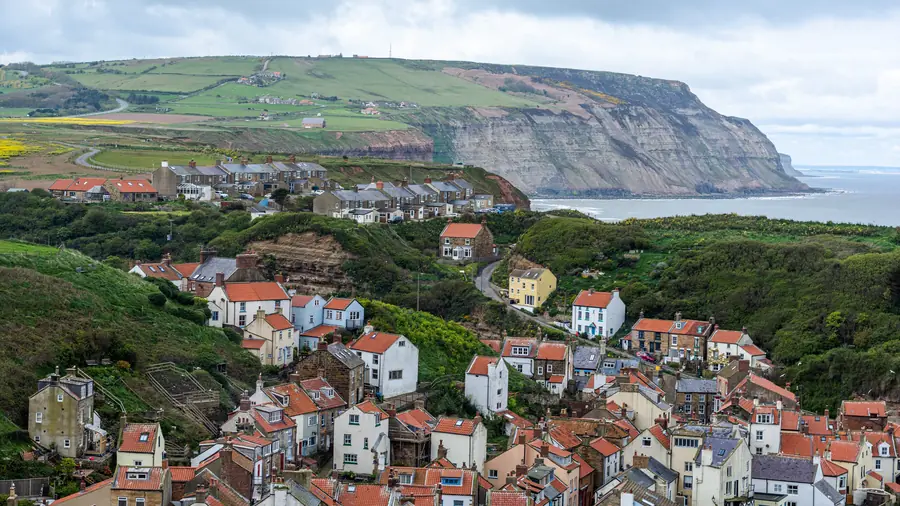
The easiest days out from Whitby are the coastal villages strung either side of it — Sandsend, Robin Hood’s Bay, Runswick Bay and Staithes — and, inland, Grosmont in the Esk valley and Goathland up on the moor, which are joined by the North Yorkshire Moors Railway. Further out, Scarborough and Pickering both make a full day rather than a half one. Below they are ordered by how far they actually are, using straight-line distances from the town centre.
Sandsend is a small fishing village at the far end of Whitby’s sands, and it is the shortest trip on this list. It began as two settlements, Sandsend and East Row, joined when cottages were built for workers in the alum industry; the old Roman Cement Mill and lime kiln still stand. Two becks, Sandsend Beck and East Row Beck, run out to the sea through the village, and both were carried over on high railway viaducts when the Whitby, Redcar and Middlesbrough Union Railway ran through here between 1855 and 1958.
What draws people now is the beach, which scores 4.7 from 696 Google reviews. It is the continuation of Whitby’s own strand, so at the right tide you can simply walk it. One reviewer notes that the beach is reached without a steep cliff path, which is not true of most of this coast, and that there is a car park and toilets. Sandsend also sits on the coastal section of the 110-mile Cleveland Way.
Without a car: the Arriva 4 and X4 buses run from Whitby up the coast towards Middlesbrough and stop here.
The best-known trip from Whitby, and deservedly. The heading distance is the straight line; the road and the Cinder Track are longer. The village is a maze of tiny streets dropping steeply to a beach, with a tradition of smuggling and a reputed network of passageways linking the houses; in 1773 two excise cutters were chased out of the bay by three smuggling vessels. In the 16th century it was a more important port than Whitby. It is on the Cleveland Way and is the finishing point of Wainwright’s Coast to Coast walk.
It rates 4.8 from 2,025 Google reviews. Recent reviewers are consistent on two things: the alleyways are the fun of it, and the descent is steep, with the car parks at the top of the hill. The beach is one of the better-known fossil sites on this coast, with ammonites in the foreshore rocks on the north side of the bay, especially after winter storms. At the bottom, the National Trust’s Old Coastguard Station has a one-room museum upstairs and a café below, 4.5 from 852 Google reviews; the volunteer-run Robin Hood’s Bay Museum takes 4.5 from 119.
Without a car: the Arriva X93 runs regularly from Scarborough to Whitby via Robin Hood’s Bay, taking about an hour end to end. By bike, the Cinder Track leaves Whitby over the 120-foot Larpool Viaduct; the standard loop out to the Bay and back is quoted at 16.4 miles (26.4 km).
Runswick Bay is a wide sandy bay north of Whitby, closed at its eastern end by the headland of Kettle Ness, where the cliffs rise to over 375 feet (114 m). Kettleness, the hamlet rebuilt inland of that headland, is 8.2 km from Whitby in a straight line and gives the honest measure of the trip; the packs carry no separate distance for Runswick village itself. Kettleness is worth knowing about in its own right: most of the old village slipped into the sea on 17 December 1829 after the headland was quarried out for alum, and the villagers escaped onto a ship anchored in the bay.
Without a car: the Arriva X4 runs between Whitby and Middlesbrough via Staithes, Runswick Bay and Sandsend. On foot it is on the Cleveland Way, and one Google reviewer in June 2026 recommended the Staithes-to-Runswick walk up the Staithes Beck side as the more manageable of the two options.
Grosmont is a railway village and it makes no secret of it. There was a Grandmontine priory here from around 1200, but the village proper was built in the 1830s around the Whitby to Pickering Railway and the Tunnel Inn, and was simply called Tunnel until at least the 1850s. Ironstone mining and an ironworks followed.
Today it is the northern terminus of the North Yorkshire Moors Railway, the second-longest preserved line in Britain, which carries more than 250,000 passengers a year between Grosmont and Pickering along George Stephenson’s 1835 route. The station takes 4.6 from 169 Google reviews. Reviewers describe watching engines come and go, touring the working engine sheds across the road, and walking through the old tunnel. The Grosmont Station Tea Room rates 4.4 from 346 Google reviews.
Without a car: this is the simplest of the lot. Grosmont is a stop on the Esk Valley Line, the Northern service that runs from Whitby to Middlesbrough, with roughly five trains a day.
Goathland sits at 486 feet (148 m) on the moor, with sheep grazed on the village green under common rights going back centuries. Its station is on the North Yorkshire Moors Railway and stood in for Hogsmeade in the Harry Potter films; the village itself was Aidensfield in Heartbeat, and the shop, garage, pub and station are all recognisable. The station rates 4.7 from 3,781 Google reviews, and reviewers mention the parking, café and toilets on site.
The other reason to come is Mallyan Spout, the waterfall the village hotel is named after, 4.7 from 1,056 Google reviews. Take the reviews seriously on the approach: several from 2026 describe a steep, unpaved descent and a rocky, slippery final stretch, with the walk in from Beck Hole the gentler option. Goathland Tea Rooms take 4.7 from 1,451.
Without a car: four buses a day serve the village on the Yorkshire Coastliner route between Leeds and Whitby, and the Coastliner 840 runs twice a day from Malton to Whitby via Pickering and Goathland, 80 minutes end to end.
The furthest of the coastal villages and the one that feels least altered. The name is Old English for landing-place. At the turn of the 20th century 80 full-time fishing boats worked out of the harbour; a century later there are a few part-timers. The old village is packed round the harbour under high cliffs, and one of its passages, Dog Loup, is 18 inches (46 cm) wide and claimed as the narrowest alley in the world. James Cook lived here as a teenager, and the community-run Staithes Museum on the High Street covers him alongside the village’s fishing and mining history, 4.5 from 310 Google reviews.
Staithes scores 4.7 from 1,972 Google reviews. As at Robin Hood’s Bay, the car parks are at the top of a steep hill and reviewers flag the climb back up. Dotty’s Vintage Tearoom takes 4.8 from 523. Port Mulgrave, just to the south, is one of the better ammonite-hunting spots on this stretch.
Without a car: the Arriva X4 from Whitby towards Middlesbrough calls here.
Scarborough is 15 miles (24 km) south of Robin Hood’s Bay down the coast and is a full day out rather than an afternoon. Its station is 26.7 km from Whitby in a straight line.
Without a car: the Arriva X93 and X94 run every 30 minutes along the coast from Scarborough, taking about an hour. Scarborough is also the far end of the Cinder Track, the 21.7-mile former railway trackbed that forms part of National Cycle Route 1 and is largely level going, though it runs a mile or two inland with limited sea views.
Pickering is the southern terminus of the North Yorkshire Moors Railway, and the steam journey is the point of going. Wikivoyage’s own recommendation is to take the train there for a well-preserved Norman castle and medieval church wall paintings. The station is 28.6 km from Whitby as the crow flies.
Without a car: most NYMR trains terminate at Grosmont, but a couple a day continue into Whitby, so a through steam run is possible in season. Timetables shown on National Rail are not definitive for these; check with the railway. The Coastliner 840 from Malton also passes through Pickering.
Grosmont. It is a scheduled stop on the Esk Valley Line from Whitby, roughly five trains a day, and the bus station in Whitby is next to the railway station. For the coast, Robin Hood’s Bay on the X93 and Sandsend on the 4 or X4 are almost as straightforward.
Sometimes. The North Yorkshire Moors Railway runs Pickering to Grosmont, where most services terminate, with a couple a day continuing into Whitby. Work began at Whitby station in 2014 to replace a platform and allow more NYMR services to be timetabled between Whitby and Pickering. Check with the railway rather than National Rail.
Robin Hood’s Bay and Staithes both put their car parks at the top of a steep hill, and Google reviewers in 2026 repeatedly warn that the climb back up is strenuous. The path down to Mallyan Spout at Goathland draws the same comments, with a rocky final section. Sandsend is the flat one.