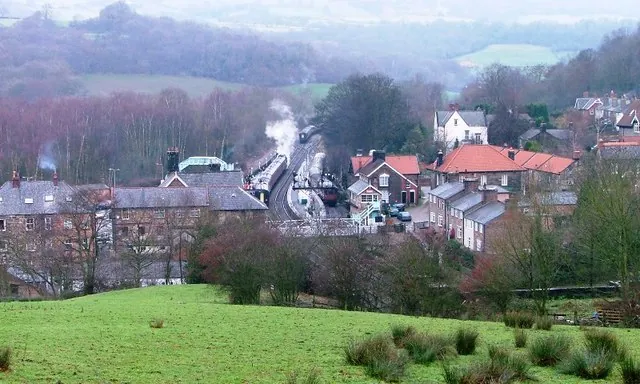
Grosmont is a small village in Eskdale, inside the North York Moors National Park, lying about 9.1 km from Whitby in a straight line. The reason to make the trip is the railway: Grosmont is the northern terminus of the North Yorkshire Moors Railway, the heritage line running south to Pickering, and it holds the NYMR’s engine shed — so this is a place to watch working steam locomotives being serviced and shunted, not only to ride behind one.
The station is the centre of everything. It works as two things at once, which a visitor in April 2023 described plainly: “Technically two stations. There is the NYMR station and the Norther Rail service.” One side is a national rail halt on the Esk Valley Line; the other is the heritage railway, with a café, a shop and toilets on the platform.
Across the road from the station is the NYMR’s motive power depot, where restoration work goes on in the sheds and can be looked at. Beyond it runs the former horse tramway tunnel of the 1830s, now a pedestrian route. A visitor in June 2026 laid out the whole circuit in one line: “Walk across the road to the Engine House, across the river and through the old tunnel.”
The village itself is short on formal attractions — one reviewer in July 2026 wrote, “Not much to do . Apart from the station I wouldn’t bother” What it does have is St Matthew’s Church, standing above the station; the Geall Gallery on Front Street; a village shop; Grosmont Cricket Club, whose ground is on Front Street and whose activity dates back to 1918; the Station Tavern beside the crossing; and the Grosmont Crossing Club. Walking is the other draw — a visitor in April 2026 noted “Plenty of walking routes.” Another, in April 2023, reported: “We did a walk in a circle around the village which took a couple of hours , went over a narrow foot bridge over a ford.”
Grosmont is unusual among Eskdale villages in that it is not old. A Grandmontine priory — one of only three in England — was founded on the banks of the Esk around 1200, burnt in 1360, and dissolved in the 1530s; the Esk crossing west of the priory site was on the line of Wade’s Causeway. But no real settlement existed until the Whitby to Pickering Railway arrived. A daily service began between Whitby and the Tunnel Inn here in May 1835, and the railway company built the inn and the post office. For years the place was simply called Tunnel.
Then came iron. The railway opened in 1836 and ironstone from Grosmont went out by rail; by 1848 the area was supplying a third of the ironworks in north-eastern England. Charles and Thomas Bagnall started Grosmont Works in 1862, with two blast furnaces by 1863 and a third in 1876. At its peak between 1865 and 1875 the works employed around 500 people and produced some 40,000 tons of iron. The population reached 1,600 in 1880. Then iron prices collapsed, the works closed in 1891, the buildings were demolished, and by 1901 the population was 872. A brickworks carried on until 1957. The 2011 census recorded 318 people in the parish.
That collapse is why the village looks the way it does: apart from post-war Ings Terrace, there has been no expansion since the nineteenth century. Several of the listed structures are railway ones — the Station Tavern, the c.1835 post office, the Murk Esk railway bridge and tunnel of 1845, and the G. T. Andrews station building of 1846 — alongside the three-arch sandstone Grosmont Bridge of around 1700. The Pickering line closed in 1963 and was reopened by volunteers as the NYMR in 1973. The actor Ian Carmichael lived in the village for many years with his wife, the novelist Kate Fenton.
Several of the road approaches have steep gradients, worth knowing if you are towing. There is a pay-and-display car park by the station; a visitor in May 2026 described the station as “a really busy station very neat and tidy with plenty of parking available”, while one in July 2023 warned that “It dies get really busy and parking can sometimes be awkward.”
There are only a handful of places to eat, all of them on or beside Front Street. In August 2026 a visitor wrote: “Not great as not many places open to eat especially when you come by train and at lunchtime.” In October 2025 another noted of the pub, “Luckily we had booked a table the day before I’m so glad we did as it was absolutely packed.” A January 2026 reviewer of the station café advised: “Suggest checking that trains are running as cafe only seems to be open when they are.” Dog owners should note a June 2026 comment: “Only downside for us is that dogs not allowed in cafe on station.”
Check before travelling that services are running. In May 2026 a visitor found the “Station currently closed for trains owing to problems with bridge. Engine shed open with viewings and some pre booked tours. Shop and cafe open.”
The direct link is rail. Grosmont station sits on National Rail’s Esk Valley Line, the route that runs inland from Whitby, and the same station is the northern end of the NYMR’s heritage line to Pickering — a visitor in October 2021 described “A train to Whitby pulled in and another pulled out to Pickering.” Coming by train also removes the parking and gradient questions entirely.
By road, the village is reached through Eskdale; the 9.1 km above is straight-line from Whitby, not road distance, and several of the access routes have steep gradients. There is also a bus interchange at the station.
The village and what is around it, at walking scale.
Open any of them in Google Maps for directions and current opening.
Want live prices and dates? GetYourGuide's booking widget shows them, and sets their cookies in your browser when it loads.
Background on Grosmont draws on its Wikipedia article, text there being available under CC BY-SA 4.0.