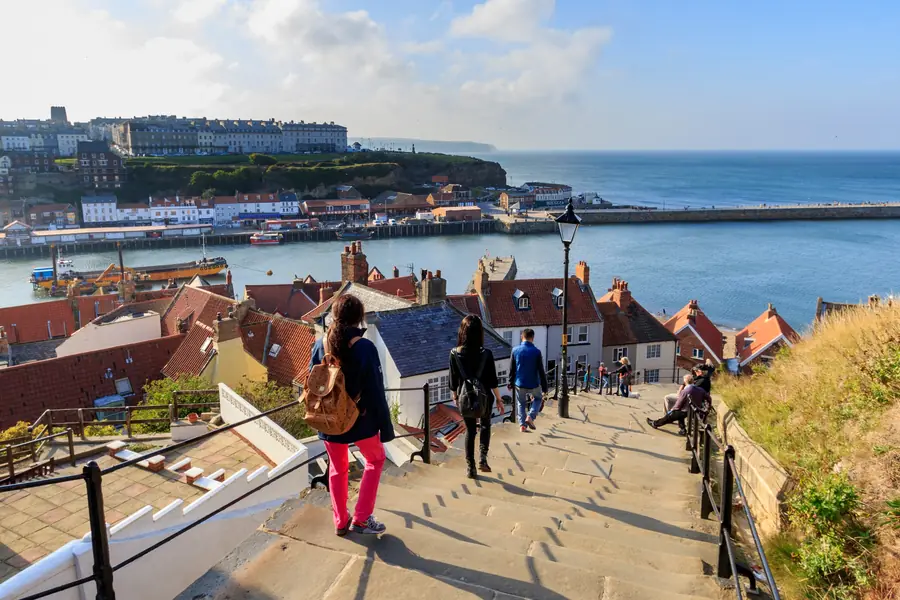
Most of what people come to Whitby for costs nothing: the 199 Steps, St Mary’s churchyard on the East Cliff, the beach, both piers, the harbour, the Whalebone Arch and the West Cliff, and Pannett Park. The one big exception is Whitby Abbey itself, which is run by English Heritage and needs a paid ticket, though you can walk right up to the boundary and see a good deal of it without one.
The steps are a grade I listed structure running from the top of Church Street in the old town up to St Mary’s Church, and they are free to climb. They have been recorded since at least 1370, were made of painted wood until around 1774, and were re-laid in stone after an act of 1764 obliged the owners to pave the route, using 103 tonnes of stone from a quarry at Sneaton. They were the funeral route to the church, and the level platforms you pass are where coffin bearers rested; the last coffin carried up this way is believed to have been that of the Reverend George Austen in 1933. The count itself was disputed for years, with John Wesley making it 191, until the churchwardens settled on 199 after a restoration in 1877. Every tenth step and the final step carry a small disc stamped with a Roman numeral so you can keep track.
They rate 4.8 from 4,515 Google reviews. Reviewers are consistent about what the climb is actually like: One reviewer notes handrails all the way up, and several mention benches to stop at. Opinion on the climb splits: some call the treads shallow and the going easier than expected, others call it steep and physically demanding, and one advises anyone with asthma, COPD or knee, hip or back trouble to take the bus to the top instead. One reviewer in December 2025 put the climb at about ten minutes; another in September 2024 said five. Several mention it gets crowded and slow in high summer. Alongside the steps runs the Donkey Road, a cobbled slope alongside, also listed grade I, with a gradient close to 50 per cent. One reviewer called it a route only ‘for those daring enough’ to push a pram or wheelchair up. One visitor in July 2026 mentioned a third route down into the old town, Caedmon’s Trod, with fewer steps.
At the top of the steps is St Mary’s Church, the Anglican parish church. The oldest parts are 12th century, but most of what you see dates from the late 18th. Nikolaus Pevsner reckoned the steps gave the best approach to it. The churchyard is open ground and free, and it is where a good number of visitors stop instead of buying an abbey ticket: one reviewer in September 2025 wrote that rather than paying to enter the ruins they “walked around the burial ground” reading the gravestones the sea salt has not yet worn away. Be aware the cliff edge here is eroding badly and the church is considered at risk.
Behind the abbey precinct the coastal path runs along the clifftop. A reviewer in October 2025 described the walk out from the back of the abbey as mostly flat and easy going, and a July 2026 visitor warned that the fence sits very close to a long vertical drop.
Whitby Abbey is not free. It is a Grade I listed ruin in the care of English Heritage, and entry to the precinct is ticketed; English Heritage members get in on their membership. Reviewers say so plainly. “Very atmospheric ruin but you do have to pay to get close. We walked around the outside which was enough for us,” one wrote in July 2026. Another, the same month: “Didn’t pay to go around the abbey just took pictures from outside.”
What you can see for nothing is the whole silhouette from the churchyard, the headland path and the boundary wall, plus the same view from across the harbour that made the ruin a sailors’ landmark for centuries. The history is worth knowing as you look at it: the monastery was founded in 657 by Oswy, King of Northumbria, with Hilda as founding abbess and the poet Cædmon among its community; the Synod of Whitby met here in 664; it was laid waste by Danish raids between 867 and 870, rebuilt on a larger scale in the 1220s as a Benedictine house, and dissolved under Henry VIII. In December 1914 the buildings were badly damaged when the German battlecruisers Von der Tann and Derfflinger shelled the headland.
If you do decide to pay on the day, two recent notes from reviewers point different ways: one in April 2026 found no queue at all and said advance tickets were unnecessary, while another in November 2025 could not get in during Goth Weekend because of the crowds and queue.
The arch is made from two lower jawbones of a whale and was put up some time after 1853, marking the town’s whaling era. North Yorkshire Council intends to replace the bones with a bronze replica. It rates 4.6 from 3,036 Google reviews, and stands on the West Cliff beside the Captain Cook monument, with benches along the grass. One reviewer in June 2026 summed the spot up: paid meter parking, pay toilets, “whalebone arch free”. The standing tip from reviewers is to shift your angle slightly and you can get the abbey into the background rather than shooting the arch head-on. A July 2026 visitor said the information board nearby is unreadable and needs replacing.
The arch sits about 330 m from the 199 Steps in a straight line across the harbour, computed from their coordinates, The arch stands on the cliff above the beach; reviewers describe steep steps down to the harbour side, and a longer way round by the road for anyone with a pushchair or wheelchair.
Whitby Beach is free, sand and shingle, and rates 4.7 from 7,093 Google reviews. It lies mostly west of the river and runs a couple of miles to Sandsend. Dogs are prohibited on the busiest sections at each end from May to September; they are allowed year-round on the middle stretch known as Upgang and on Tate Hill beach east of the river.
Tides matter here more than anywhere else on this list. A June 2026 reviewer wrote that they “mistimed and nearly got stuck with high tide”, and a June 2025 one warned that in the shadow of the cliffs there is no mobile signal, so check tide times before a long walk towards Sandsend. Access is down steep slopes, which several reviewers found hard work. There is sometimes surf, and a brisk shoreline current.
The West Pier is open to walk. The West Pier rates 4.9 from 77 Google reviews, has a memorial to Whitby’s fishermen and plenty of seating, and gives a clear view back to the abbey. Reviewers repeatedly mention wide gaps between the deck planks near the far end, and posted warnings about standing near the barriers in rough weather when waves come over. The lighthouses on the east and west piers are harbour lights rather than the real thing; the Whitby High Lighthouse is on the clifftop two miles east, beyond Saltwick Bay, and is now a private house. Back in the harbour, watching the swing bridge open for boats is a fixture of a Whitby afternoon and costs nothing.; the working lifeboat station is on the opposite bank, on Church Street.
Pannett Park rates 4.6 from 2,064 Google reviews and sits about 350 m from the railway station in a straight line. The park is free; Whitby Museum, which stands in its grounds, is ticketed. Reviewers describe well-kept borders, a tree trail with a Jurassic planting, a flower clock and timeline, sculptures, benches with views across to the abbey, a well-equipped playground, and famously tame grey squirrels. It is hilly, the tarmac paths avoid most of the steps, and step-free entry is from the top road. Dogs are not allowed, which several reviewers were unhappy about and others liked.
The Cleveland Way runs 110 miles from Helmsley around the moors, and the sections either side of Whitby follow the clifftops: northeast via Sandsend, Runswick Bay and Staithes towards Saltburn, southwest via Robin Hood’s Bay and Ravenscar towards Scarborough. Sandsend is 4.1 km from Whitby and Robin Hood’s Bay 7.8 km, both straight-line distances. The Cinder Track, the old Whitby to Scarborough railway, is level going for walkers, cyclists and riders, though one cyclist reported it rough and muddy in places and advised a mountain bike.
The walking is free; getting there and parking usually is not. Reviewers complain constantly about summer parking in Whitby, with one in June 2026 reporting machines out of order and long walks back to the car.
No. The ruins are owned and maintained by English Heritage and entry is ticketed, free only to members. The churchyard of St Mary’s next to it, the 199 Steps and the clifftop path are all free, and plenty of reviewers say the outside view was enough for them.
Free to climb, and there is no ticket or gate. Reviewers put the climb at somewhere between five and ten minutes. Some describe shallow treads, handrails and benches to rest on; others call it steep and a real workout, and one advises visitors with breathing, knee, hip or back problems to take the bus to the top instead. If steps are a problem, reviewers point to the headland car park at the top, or the open-top tour bus, rather than the steps; the Donkey Road alongside is a near-50 per cent cobbled gradient and no easier., and one reviewer recommends Caedmon’s Trod as a route with fewer steps.
The beach at low tide, counting the numbered discs up the 199 Steps, the playground and the tame squirrels in Pannett Park, and walking out along the West Pier. At Robin Hood’s Bay, 7.8 km away, reviewers report rock pools and fossil hunting on the beach at low tide, though reviewers report paying to park at the top of the village in season.