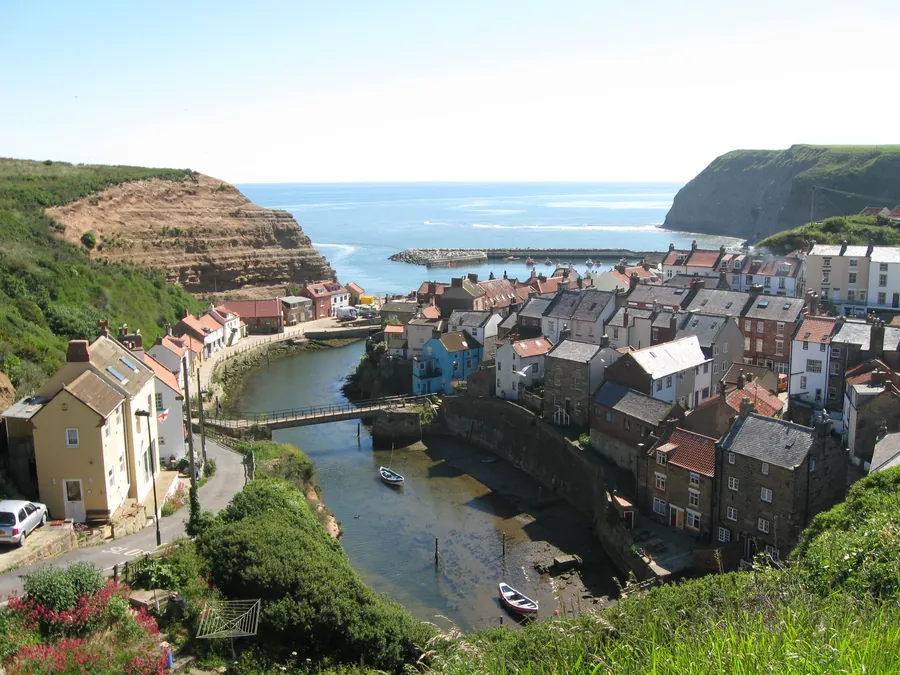
Staithes is an old fishing village on the coast north-west of Whitby, its oldest part clustered around the sheltered harbour and bounded by high cliffs with a harbour sheltered by two long breakwaters. For anyone staying in Whitby it works as a half-day out: the same coast at a smaller scale, with narrow passageways, a rocky beach, a village museum, harbourside pubs and tearooms, and the village where James Cook worked as a shopkeeper’s apprentice before he ever went to sea.
It lies roughly 13.9 km from Whitby in a straight line — a map measurement, not a road distance or a walking time — inside the North York Moors National Park, on the boundary with Redcar and Cleveland.
There are effectively two Staithes: the modern upper village around the junction of the High Street and the A174, and the older part clustered around the harbour below. The old village is a knot of narrow streets and passageways, one of which — Dog Loup, 18 inches (46 cm) wide — is claimed to be the narrowest alley in the world. The harbour jetties are open to walk out along: a visitor in July 2026 described “Accessible harbour jetties giving fantastic views of the harbour, village and beach.”
Google lists Staithes Museum, Dotty’s Vintage Tearoom on the High Street, Staithes Beck Bridge and a lobster sculpture — so expect wandering rather than ticking things off. A reviewer in April 2026 wrote that “Once there, it is beautiful although not loads to do or see.” The Cod and Lobster on the harbour front recurs in reviews, and is a stop on the local pub crawl known as the Roxby Run.
The beach is rock as much as sand, and the cliffs are Jurassic (Lias) strata that draw geologists. A rare seagoing-dinosaur fossil turned up in the early 1990s after a rockfall between here and Port Mulgrave to the south, which is one of the better places on this coast for ammonites. Tide matters: a visitor in May 2026 called it “Great for exploring the rocks and fossil hunting at low tide.”
James Cook worked in Staithes for a local merchant and banker, William Sanderson, between 1745 and 1746. Sanderson’s shop was destroyed by the sea around 1850, and parts of it were recovered and built into Captain Cook’s Cottage on Church Street. Later the village drew around 50 painters known as the Staithes Group, or Northern Impressionists; Dame Laura Knight and her husband Harold Knight painted here for years.
Staithes Museum occupies the disused Primitive Methodist chapel on the High Street. Set up by Reginald Firth in 1993 and run by a charitable trust since 2019, it covers village history and Cook, is run on donations, and holds a 4.5 rating from 310 Google reviews. A visitor in July 2026 called it “Compact but well put together, over 2 floors, interesting displays and quirky gift shops within.” One in August 2023 said it was “Well worth a look, especially on a rainy day” — useful if the weather turns.
The village’s own traditions are documented at length: the hand-sewn Staithes Bonnets worn by the fishing women, the superstition against saying the word “pig” (locally “grecians” or “grunters”), the mermaid who cursed the village on escaping. Two annual fixtures: the RNLI Lifeboat Weekend in August, with its nightgown parade, and the Staithes Festival of Arts and Heritage each September, when houses across the village open as pop-up galleries.
The thing to know: you park at the top and walk down, and visitor cars do not go into the old village. A reviewer in July 2026 noted that the public car parks “are at the top of a steep hill that leads down to the village,” that “less mobile people may need to consider this prior to visiting,” and that “there are however many seats to rest on during the descent or ascent.” As a June 2026 review puts it, “Residents only can drive down.” Another, in May 2026, notes there is “a large cafe and toilets” at the car park. A May 2026 visitor called the descent “approx 5-10 minutes”; it is the climb back that people mention.
Parking, rather than the streets, is the constraint when it is busy. A February 2026 visitor wrote “I could imagine during warmer times it’s difficult to park,” and a May 2026 one that “It can be a bit difficult to find a parking spot.” Out of season it empties: a visitor writing in October 2025 said “We went out of season at the end of September and it was absolutely bliss. One day, we were the only people on the beach.”
By road, the A174 between Thornaby-on-Tees and Whitby bisects the southern end of the village, so it is one coast road out of Whitby to the car parks at the top of the hill. There is no train: Staithes railway station, on the Whitby, Redcar and Middlesbrough Union Railway, served the village from 1883 until 1958. A reviewer in October 2024 called at the museum “on our way up to catch a bus back to Whitby,” so a bus service exists; check it before relying on it.
On foot, Staithes sits on the Cleveland Way, which runs south-east towards Runswick Bay and Whitby and and west past Boulby Cliff, a mile away, towards Skinningrove; alum was once extracted from quarried shale at Boulby, and the ruined remnants of the mines can be seen from the cliff top by walkers on this stretch. A walker in June 2026 advised: “Instead of going up by Cowbar Nab (full of spiky shrubs, bare legs and trousers won’t like it), I recommend going up the other side of the river (Staithes Beck) to Runswick Bay which is further but with a much more accessible trail with gorgeous views.”
The village and what is around it, at walking scale.
Open any of them in Google Maps for directions and current opening.
Want live prices and dates? GetYourGuide's booking widget shows them, and sets their cookies in your browser when it loads.
Background on Staithes draws on its Wikipedia article, text there being available under CC BY-SA 4.0.